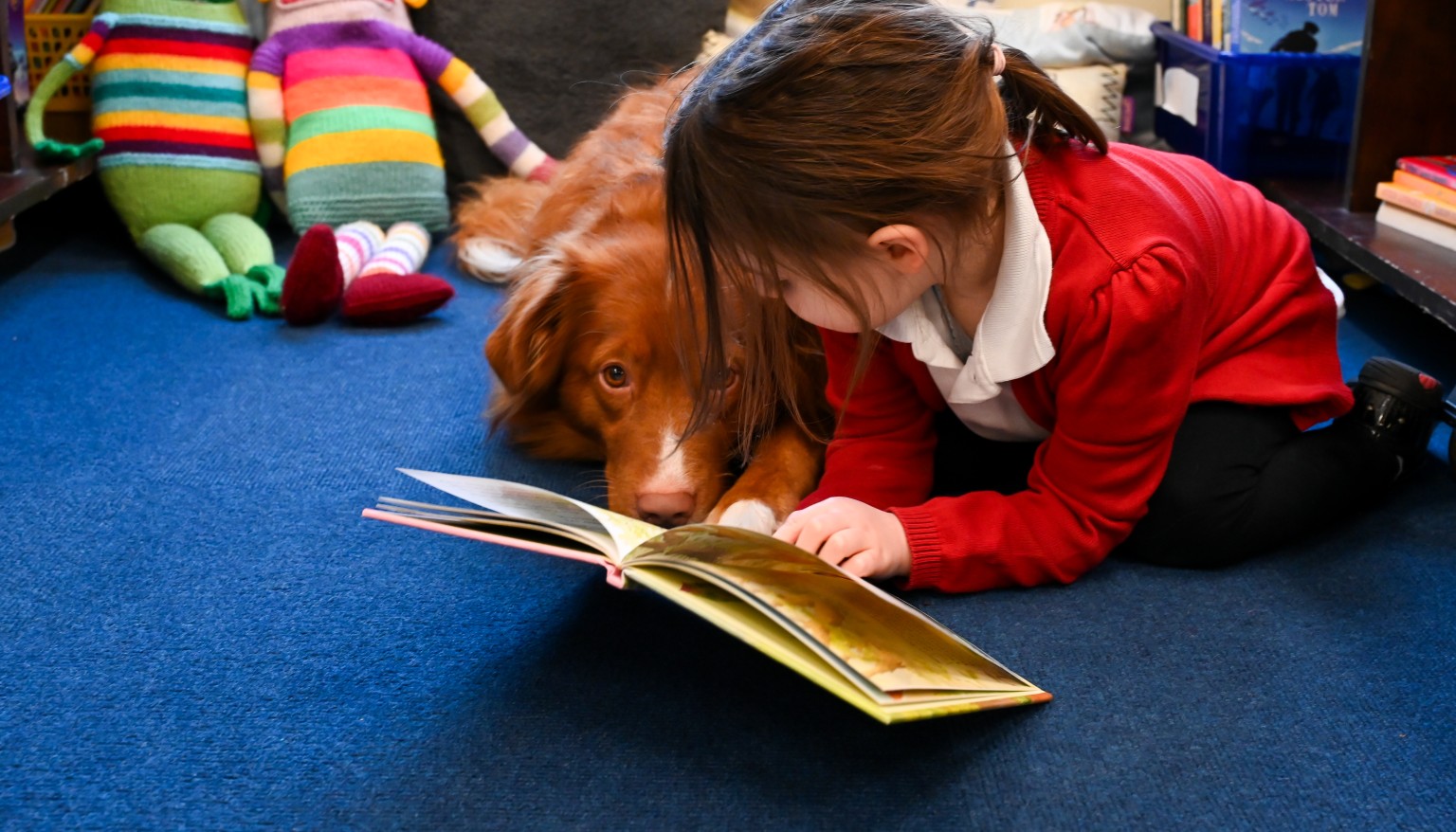
“The most important skill for children to learn is how to read.”
Department for Education
At Cavendish Church of England Primary School, we believe that every child can become a fluent and confident reader.
Learning to read is fundamental to children's success across the curriculum. It gives them access to knowledge, stories, vocabulary and ideas and enables them increasingly to learn independently.
Our aim is for children to learn to read accurately, fluently and with understanding, while developing the confidence and enjoyment that will help them see themselves as readers for both pleasure and purpose.
Early reading reflects our school vision: We Learn. We Love. We Belong. Children learn the knowledge and skills that unlock reading; they experience the joy of sharing books and stories; and every child is supported to become part of our community of readers.
Our Phonics Programme
We teach early reading through Little Wandle Letters and Sounds Revised, a systematic synthetic phonics programme.
Phonics begins in Reception and follows the Little Wandle progression so that children systematically build their knowledge of the alphabetic code, learning to recognise grapheme–phoneme correspondences, blend sounds to read words and apply their phonics increasingly fluently when reading and spelling.
We use the same language, routines and resources across the school so that children experience a consistent approach and unnecessary cognitive load is reduced. All staff involved in teaching early reading are trained in the programme, and our Reading Leader and senior leaders monitor teaching, assessment and pupil progress.
Daily Phonics Teaching
Children in Reception, Year 1 and Year 2 receive daily phonics teaching.
In Reception, children make a strong start. Teaching begins in Week 2 of the Autumn term, initially through shorter sessions and daily oral blending before building towards the full 30-minute lesson.
Children progressively learn:
- in Reception, Phase 2 and Phase 3 GPCs and words containing adjacent consonants;
- in Year 1, they review earlier learning before developing their knowledge of Phase 5 GPCs; and
- in Year 2, they review Phase 5 before progressing to Little Wandle Bridge to Spelling and the Little Wandle Year 2 spelling units.
Each Friday includes review of the week's teaching so that important knowledge is revisited and secured.
Learning to Blend
Blending is essential for becoming an independent reader.
From the beginning of Reception, children are explicitly taught how to blend sounds together to read words.
Children who are not yet able to blend receive additional daily blending practice in small groups, ensuring that they develop this essential skill quickly and can begin accessing matched reading books.
We want children to move from sounding and blending individual words towards increasingly automatic and fluent reading, freeing their attention to focus upon meaning.
Reading Practice
Reading practice is carefully connected to children's phonics learning.
Children read fully decodable books matched precisely to the phonic knowledge they have securely learned. This ensures that children can apply what they know successfully rather than being expected to guess unfamiliar words.
In Reception, reading practice sessions take place three times each week in small groups with a trained adult. The sessions have three distinct focuses:
Decoding – applying phonics accurately to read words.
Prosody – reading with appropriate phrasing, expression and understanding.
Comprehension – understanding and discussing what has been read.
Reception reading practice begins from Week 4 once children have developed sufficient early phonic knowledge.
In Years 1 and 2, matched reading practice takes place daily through paired reading. Children read together from carefully matched decodable texts while trained adults monitor, support and assess reading. The class teacher also listens regularly to groups to ensure progress is understood and books remain appropriately matched.
Keep-Up: Keeping Children with Their Peers
We believe that difficulties with early reading should be addressed quickly and precisely.
Any child who needs additional practice receives daily Keep-up support delivered by a trained adult.
Keep-up lessons mirror the language, structure, procedures and resources of the main Little Wandle lesson, but use smaller steps and additional repetition.
These short, focused sessions usually last around 15–20 minutes and are intended to help children secure missing knowledge quickly so that gaps between them and their peers do not widen.
Children in Reception and Year 1 who are receiving additional Keep-up also read their matched reading practice book to an adult each day.
Rapid Catch-Up Beyond Key Stage 1
Our commitment to early reading does not end simply because a child becomes older.
Where pupils in Years 2–6 still have gaps in their phonic knowledge, we use the Little Wandle Rapid Catch-up programme.
Children are assessed to identify precisely what they need to learn, receive targeted teaching and continue with matched decodable reading for as long as it is required.
Fluency assessments help us determine when children have developed sufficient accuracy and reading speed to leave the programme and access age-appropriate reading more independently.
For pupils following Rapid Catch-up in Years 2–6, assessment and teaching continue until gaps in the alphabetic code and reading fluency have been addressed.
Fluency
Reading successfully is about more than decoding individual words.
Children need to move towards reading with accuracy, automaticity, appropriate pace and expression so that they can concentrate upon understanding what they read.
Little Wandle fluency assessments are used at appropriate stages to assess children's accuracy and reading speed.
Within the programme, children are taught not only to decode but also to develop prosody — reading with phrasing and expression that demonstrates understanding.
Developing secure fluency provides the bridge between learning to read and becoming a reader who can learn confidently from increasingly complex texts.
Language and Comprehension
Phonics is essential, but early reading at Cavendish is broader than phonics alone.
We place a strong emphasis upon speaking, listening and language development, because children need a rich vocabulary and strong oral language to understand what they read.
Through stories, shared reading, conversation and reading practice, adults help children develop vocabulary, understand texts and talk about characters, events and ideas.
As children become increasingly secure readers, they learn to use their decoding and language knowledge together to read for meaning.
Reading at Home
Families are important partners in children's reading development.
The decodable book children have practised successfully in school is taken home so that they can read with confidence and celebrate their success with their family.
Children also take home books for adults to share with them for pleasure. These books are not restricted to children's current decoding level because their purpose is different: they allow children to enjoy richer stories, vocabulary and ideas through being read to.
We use Little Wandle parent resources, workshops and guidance to help families understand how phonics is taught, how children learn to blend and how they can support reading positively at home.
Reading for Pleasure
Learning the mechanics of reading and loving books go hand in hand.
Children are read to every day and encounter a carefully chosen range of books. We want literature both to reflect the children and community of Cavendish and to provide windows into other lives, cultures and worlds.
Classrooms provide inviting reading areas, Reception children have daily access to books within provision, pupils use the school library and children encounter wider reading experiences such as author visits, workshops, book fairs and national reading events.
Our aim is not simply to produce children who can read, but children who increasingly choose to read.
The Cavendish 5 in Early Reading
Our Cavendish 5 support the effective teaching of phonics and early reading.
Retrieval
Previously taught GPCs, words and blending skills are revisited frequently so that knowledge becomes secure and automatic.
I Do, We Do, You Do
Adults explicitly model pronunciation, blending and reading before practising with children and supporting them towards independence.
Purposeful Practice
Children have frequent opportunities to apply taught phonics through word reading, spelling and precisely matched decodable books.
High-Quality Questioning
Adults check children's understanding of sounds, words, vocabulary and texts and use questions to develop comprehension.
Feedback
Misconceptions are addressed immediately through precise correction, additional modelling and Keep-up teaching where needed.
Inclusion and High Expectations
Our expectation is that every child will learn to read.
We do not wait for children to fail before providing support.
Daily assessment within lessons helps teachers identify children who need further practice. Keep-up teaching, additional blending and Rapid Catch-up provide increasingly targeted support while retaining the same teaching language and approach.
This means children receive more practice and smaller steps where necessary, not a different or less ambitious curriculum.
Our Early Reading Policy is explicit that teaching every child to read is a whole-school priority, led and monitored through our Reading Leader and senior leadership team.
Assessment
Assessment is used to make sure that children receive the right teaching at the right time.
Teachers assess informally every day and use the weekly review lesson to identify and address gaps.
Formal Little Wandle assessment takes place every six weeks in Reception, Year 1 and Year 2, enabling teachers and leaders to monitor progress, identify children who need additional support and plan appropriate Keep-up teaching.
Children new to Cavendish are assessed promptly so that any gaps in phonic knowledge are identified. For older pupils, the Rapid Catch-up assessment is used where appropriate.
In Year 1, pupils complete the statutory Phonics Screening Check. Any pupil who does not meet the required standard is supported further and completes the check again in Year 2.
Early Reading and Our Christian Vision
Learning to read gives children voice, independence and access to the wider world.
Our Christian vision calls us to recognise the dignity, potential and worth of every child. In Early Reading, this means having the highest expectations for every pupil and acting quickly when a child needs additional support.
Books also help children encounter stories and experiences beyond their own, building curiosity, empathy and understanding.
Through reading together, sharing stories and celebrating children's growing independence, we create a reading community in which children know that they are supported, their progress matters and they belong.
The Impact of Early Reading at Cavendish
By the end of Key Stage 1, we want children to have developed secure phonics knowledge, accurate decoding and increasing fluency, enabling them to access the wider curriculum confidently.
Children should know how to tackle unfamiliar words, read increasingly automatically and understand what they read.
Those who require longer to secure these skills continue to receive carefully targeted phonics teaching through Little Wandle and Rapid Catch-up beyond Key Stage 1.
Above all, we want every child to leave the early stages of reading believing:
I can read. I understand what I read. I am a reader.
We Learn. We Love. We Belong.