“Music is a universal language that embodies one of the highest forms of creativity.”
National Curriculum for Music
At Cavendish Church of England Primary School, Music gives every child opportunities to listen, sing, play, create, compose and perform.
We want our children to experience the enjoyment of making music together while developing the knowledge and practical skills that enable them to become increasingly confident and independent musicians. Through regular listening, rehearsal, performance and reflection, pupils learn not simply to experience music, but to become more musical.
Music reflects our school vision: We Learn. We Love. We Belong. Children learn new skills and musical knowledge; they experience the joy of creating and performing with others; and music provides powerful opportunities for every child to contribute, participate and belong.
Our Music Curriculum
We use Kapow Primary Music as our core curriculum and follow its two-year mixed-age programme.
As Kapow Music is newly introduced at Cavendish, we have deliberately begun with Cycle A in 2026/27, followed by Cycle B in 2027/28. This provides a clear starting point for the new curriculum and allows pupils to establish important musical foundations before revisiting and developing their knowledge with increasing depth and independence.
Across the two-year programme, children develop as:
- listeners and evaluators;
- creators of sound;
- users of musical notation;
- improvisers and composers; and
- performers through singing and playing.
The important building blocks of music — including pitch, duration, pulse, rhythm, dynamics, tempo, timbre, texture and structure — are revisited throughout the curriculum so that children develop increasing understanding, control and confidence.
Our Mixed-Age Class Structure
Our Music curriculum is specifically organised around the mixed-age structure of Cavendish.
Robins – EYFS, Year 1 and Year 2
Reception children follow linked Kapow EYFS musical experiences, while Year 1 and Year 2 pupils follow the named mixed-age Key Stage 1 units. Children may share listening, singing and performance experiences, but the expected outcomes remain developmentally appropriate.
In Reception, children explore sound, movement, songs, musical stories and simple performance. In Key Stage 1, these foundations develop through learning about pulse, tempo, pitch, dynamics, sound patterns, instruments, musical symbols, singing and structure.
Wrens – Year 3 and Year 4
Children develop greater musical control through singing, instrumental work, composition and ensemble performance.
Across the two-year programme, pupils experience music from a range of traditions and styles through units including South African and Caribbean instrumental music, singing, percussion, jazz, Rock and Roll, ballads, samba and composition.
Our Cycle A programme deliberately includes sustained instrumental learning so that children can develop technique, musical memory, ensemble awareness and confidence over time.
Owls – Year 5 and Year 6
Children develop increasing fluency, expression and independence as musicians.
Their curriculum includes experiences such as film music, composition and notation, musical theatre, theme and variations, songs from the Second World War, looping and remixing, blues, orchestral music and music from South and West Africa.
Children increasingly make and justify their own musical decisions, compose with greater sophistication, use notation and perform with accuracy, expression and awareness of others.
In the summer term, Owls also have the opportunity to bring their learning together through composing and performing a Leavers' song.
Becoming Musicians
At Cavendish, Music is a practical subject.
Children learn musical knowledge through doing: listening closely, copying, rehearsing, singing, playing, improvising, composing and performing.
As pupils progress, they develop different forms of musical knowledge. They learn about musical concepts and vocabulary, but they also develop the practical knowledge needed to control their voices and instruments and the increasingly intuitive understanding that comes from repeated musical experience.
We therefore place great importance on children having regular opportunities to hear, practise and refine music, rather than simply learning facts about it.
The Cavendish 5 in Music
As in all subjects at Cavendish, our Cavendish 5 underpin high-quality teaching and learning in Music.
Retrieval
Children revisit musical vocabulary, previous repertoire, rhythms, pitch patterns, notation and techniques so that new learning connects securely with what they already know.
I Do, We Do, You Do
Teachers model musical techniques clearly, rehearse alongside pupils and gradually support children towards increasingly independent performance and composition.
Purposeful Practice
Music requires practice. Children have repeated opportunities to rehearse singing, instrumental parts, rhythms, melodies and compositional ideas so that control and fluency develop over time.
High-Quality Questioning
Children are encouraged to listen carefully, compare, explain what they hear, identify musical features and justify choices made when performing or composing.
Feedback
Immediate feedback during rehearsal helps children refine technique, improve ensemble performance and make purposeful changes to their compositions.
Music in the Early Years
Music is an important part of children's experience from the moment they join Cavendish.
Within Reception, children develop musical foundations principally through Expressive Arts and Design, alongside Communication and Language, Physical Development and Personal, Social and Emotional Development.
Children sing, move to music, explore their voices, use body percussion and instruments, notice changes in sound and begin to create and perform simple musical ideas.
Kapow's EYFS experiences are flexible and can be revisited through continuous provision and class themes, enabling children to encounter music frequently and playfully.
These experiences prepare children for the more structured musical learning they encounter in Key Stage 1.
Singing
Singing is an important part of musical life at Cavendish.
Through classroom Music, children learn to use their voices with increasing accuracy, fluency, control and expression. They learn to sing together, listen to others, respond to musical cues and experience the sense of shared achievement that comes from making music as an ensemble.
Singing also features within collective worship, performances and wider school life.
These additional musical opportunities enrich our curriculum, but they complement rather than replace our taught Music lessons.
Instrumental Learning
Learning to play instruments enables children to develop an increasingly sophisticated understanding of how music works.
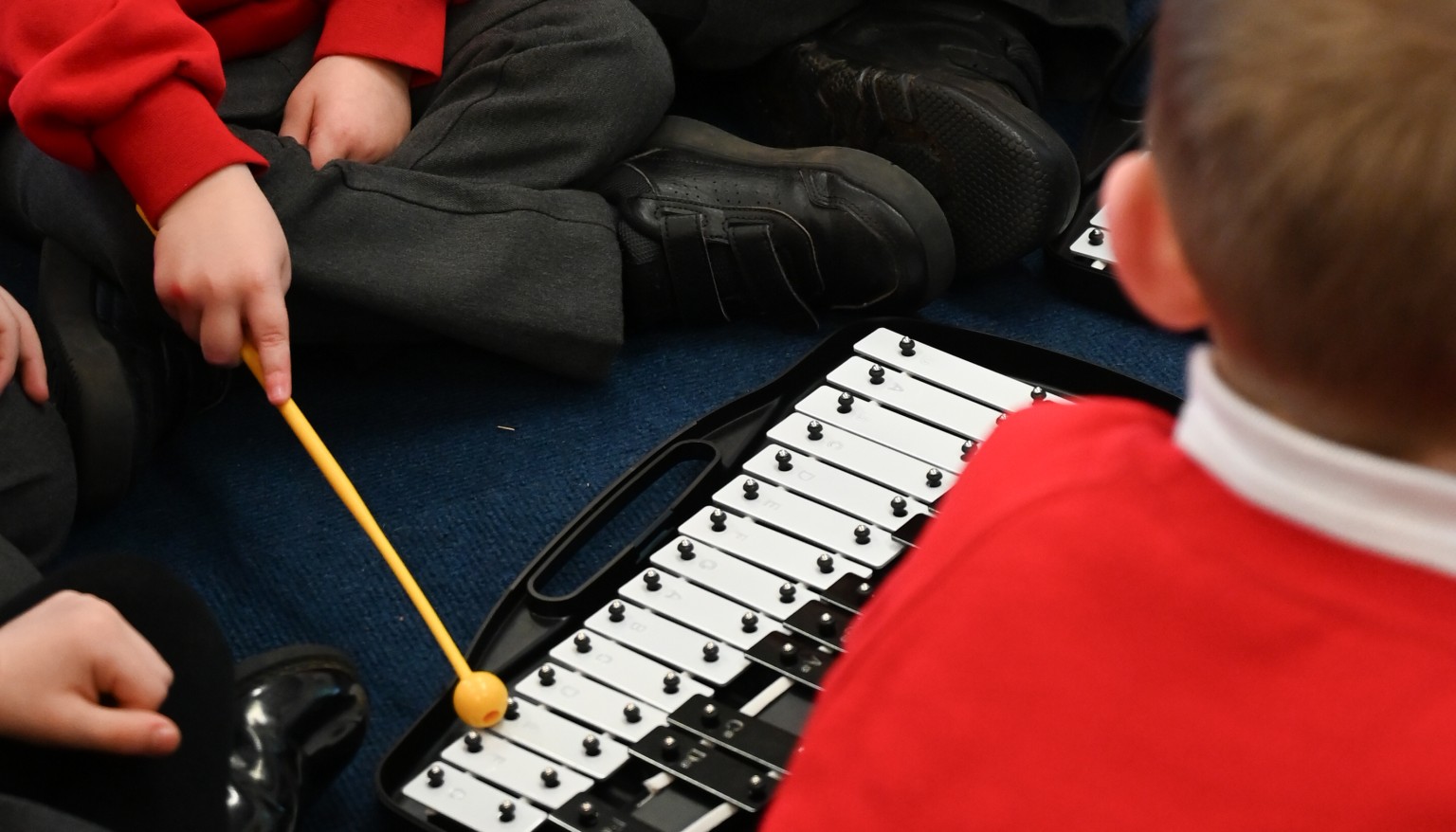
Children encounter both tuned and untuned instruments throughout the curriculum and develop their ability to create and control sound.
In Wrens, sustained instrumental units provide opportunities to develop technique over time. Our Cycle A programme includes instrumental learning through South African and Caribbean musical traditions, enabling children to develop pulse, rhythm, notation and ensemble performance through repeated practice.
As pupils progress, they learn to sustain their own part while listening to others, maintain a pulse within an ensemble and perform with increasing confidence and independence.
Listening and Musical Diversity
Children listen to a wide range of music drawn from different styles, periods, traditions and cultures.
Our planned curriculum includes music connected with South Africa, the Caribbean, jazz, Rock and Roll, samba, blues, South and West Africa, orchestral music, film, musical theatre and historical repertoire.
Listening is active rather than passive. Children learn to recognise and discuss musical features, compare pieces, understand something of their cultural or historical context and use what they hear to influence their own performing and composing.
This helps children understand that music is both a shared human experience and something expressed in wonderfully diverse ways across communities and cultures.
Improvising, Composing and Creating
Children are musicians not only when performing someone else's music, but when creating music of their own.
From experimenting with and combining sounds in Robins, pupils progress to improvising, developing motifs and creating increasingly structured compositions.
Older children explore composition through contexts including animation, film, poetry, festivals, themes and variations and music technology.
Children learn to generate musical ideas, rehearse them, listen critically and make changes. They begin to understand that composing, like writing or designing, involves creating, evaluating, refining and improving.
Inclusion in Music
Music is for every child.
Teachers adapt access without reducing the ambition of the musical learning.
This may include using visual cues, echo practice, reduced note sets, repeated modelling, simplified instrumental parts or additional rehearsal. Pupils may access the same musical goal through appropriately adapted parts while remaining fully included within the shared performance.
Children who are more musically secure are challenged through greater independence, more complex parts, improved technique, musical leadership, evaluation and increasingly sophisticated compositional choices.
We want every pupil to experience what it feels like to contribute meaningfully to making music together.
Assessment in Music
Assessment in Music focuses on what children know, hear and can increasingly do as musicians.
Teachers assess pupils through listening to them sing and play, observing rehearsal, talking with children about music and considering their improvisations, compositions and performances.
We consider children's developing ability to:
- listen and respond musically;
- control their voice and instruments;
- maintain pulse and rhythm;
- understand and use musical vocabulary;
- use appropriate notation;
- improvise and compose;
- rehearse and refine musical ideas; and
- perform with increasing accuracy, fluency, control and expression.
Assessment is used to identify what children need to practise or revisit so that future teaching builds securely upon previous musical learning.
Music Beyond the Classroom
Music has an important place in the wider life of Cavendish.
Alongside curriculum Music, children encounter music through collective worship, performances, instrumental tuition and enrichment opportunities.
These experiences give children additional opportunities to perform for others, develop confidence and celebrate musical achievement.
They also help make music something that is heard, shared and valued across the life of our school.
Music and Our Christian Vision
Music has a special ability to bring people together.
Singing and performing as part of a group requires children to listen to one another, contribute their own part and recognise that the quality of the whole depends upon everyone within it.
This connects strongly with our Christian vision and our understanding of community, dignity and belonging.
Music also creates opportunities for joy, creativity, reflection and spiritual development. Through encountering music from different traditions and cultures, children recognise both the diversity of human experience and the things that connect us.
Every child's musical contribution matters.
The Impact of Music at Cavendish
By the time children leave Cavendish, we want them to see themselves as musicians.
They should have developed the confidence to sing, play and perform; the knowledge to listen and talk about music with increasing understanding; and the skills to improvise, compose and communicate their own musical ideas.
They should have encountered music from a rich variety of cultures, traditions and styles and developed increasing control of the musical building blocks they have revisited throughout school.
Most importantly, we want children to leave Cavendish with a lasting enjoyment of music, confidence in their own musical voice and an understanding of the powerful experience of creating something together.
We Learn. We Love. We Belong.